USA TODAY Network · Earth Day 2025
Parents find ways to decarbonize
Planet-friendly practices help reduce the environmental impact of child-rearing
By Matt Alderton, USA Today · April 20, 2025
Angela Betancourt is a proud thrifter. “I’ve been a thrifter since before it was cool,” says Betancourt, 42, of Miami. “Growing up, we did not have a lot of money. My mom raised us a single mom with the help of her sister, my awesome aunt, and we never had a lot of the things that other kids had. We shopped at thrift stores out of necessity, and I still shop at thrift stores today. That’s been my thing forever.” In 2023, Betancourt suddenly had a new thing: her first-born child, Max, whom she wanted to dress to the nines.
“I was so blessed to have lovely family and friends who gifted me a lot of clothing at my baby shower, and I also purchased some really cute things for him. I wanted him to look preppy, so I spent $40 on this adorable cable-knit sweater. He looked straight out of a Ralph Lauren baby ad. He was the cutest kid ever,” Betancourt said. “But he only wore that sweater for, like, two and a half weeks. And then it didn’t really fit him anymore. It felt like such a waste.”
When a friend gifted Max a windfall of hand-me-downs that she’d purchased for her own child for $15 at a thrift store, Betancourt had an epiphany. “I asked, ‘Why am I not thrifting for Max like I thrift for myself?’ ” she says. “I decided it didn’t make sense financially for me to continue buying new things for him when he is only going to wear them for a short amount of time.”
It didn’t make sense environmentally, either. “I started thinking about how many baby things must get thrown out every year, and it reminded me of why I love thrifting in the first place: It’s not just good for your pocketbook, but also for the planet,” Betancourt says. “I want my son to grow up thinking consciously about the environment, and I want to teach him by example.”
Betancourt isn’t the only parent who feels that way. A 2024 survey conducted by Talker Research for Chinet found that 7 in 10 parents believe their generation has a responsibility to make sustainable decisions that will make the world better for their children. A 2023 survey conducted by Morning Consult for HP likewise found that 91% of parents are concerned about the climate crisis, and that nearly two-thirds of parents prefer to purchase products that are sustainably sourced.
For moms, dads and other family members who care about their kids and the planet they’ll inherit, an obvious place to begin practicing better environmental stewardship is with the $321.5 billion baby products market, which every year generates untold heaps of emissions and waste that will blemish the Earth for generations to come.
Cleaning up kids’ clothing
The fashion industry is rife with waste. Fashion designers generate waste when they’re testing and cutting fabrics for their collections, for example. Manufacturers and retailers generate waste by overproducing garments that they never actually sell. And consumers generate waste every time they return or discard clothing that doesn’t fit or that they no longer want in their wardrobe.
Often, that waste ends up in landfills.
Baby clothes are even more wasteful because of the speed at which kids outgrow them, according to Fady Kasbar, founder of the startup app Blossoms, which he describes as a “first-of-its-kind gamified marketplace where parents can claim pre-loved children’s clothing for free, using in-app rewards instead of money.”
“The way I see it, there’s no reason for families to buy kids clothing ever again because there’s so much of it that exists already. There’s literally tons and tons of it,” Kasbar says. “Many brands have worked to make children’s products more sustainable with things like organic materials, biodegradable packaging and ethical production, but even the greenest products still require new production. The most impactful solution isn’t just making better products; it’s helping parents consume less in the first place.”
Better baby gear
The environmental problems that exist with kids’ clothing—including overconsumption, short product lifespans and excessive waste—also exist for other baby and children’s products, according to Vince Guidice, founder and CEO of Evrloop, which claims to be the first fully circular baby gear brand dedicated to keeping its products out of landfills.
Solutions that work for clothing, however, may not be appropriate for other product categories. “The secondhand market is growing, which is fantastic and probably the best thing you can do from an environmental standpoint. But it’s not necessarily practical where there are safety risks,” Guidice explains. “Parents are extremely concerned about product safety, so demand for used baby gear is quite low.”
In fact, many donation centers refuse donated baby gear because of liability concerns. So, even the best-intentioned parents often end up sending old strollers, car seats and highchairs to landfills.
Evrloop hopes to change that by making baby gear from 100% regenerative and recycled materials, and by offering with each of its products a lifetime buyback guarantee.
“If we stick to our mission of taking products back and reusing parts that are in mint condition, over time we’ll become our own supplier of raw materials,” Guidice says.
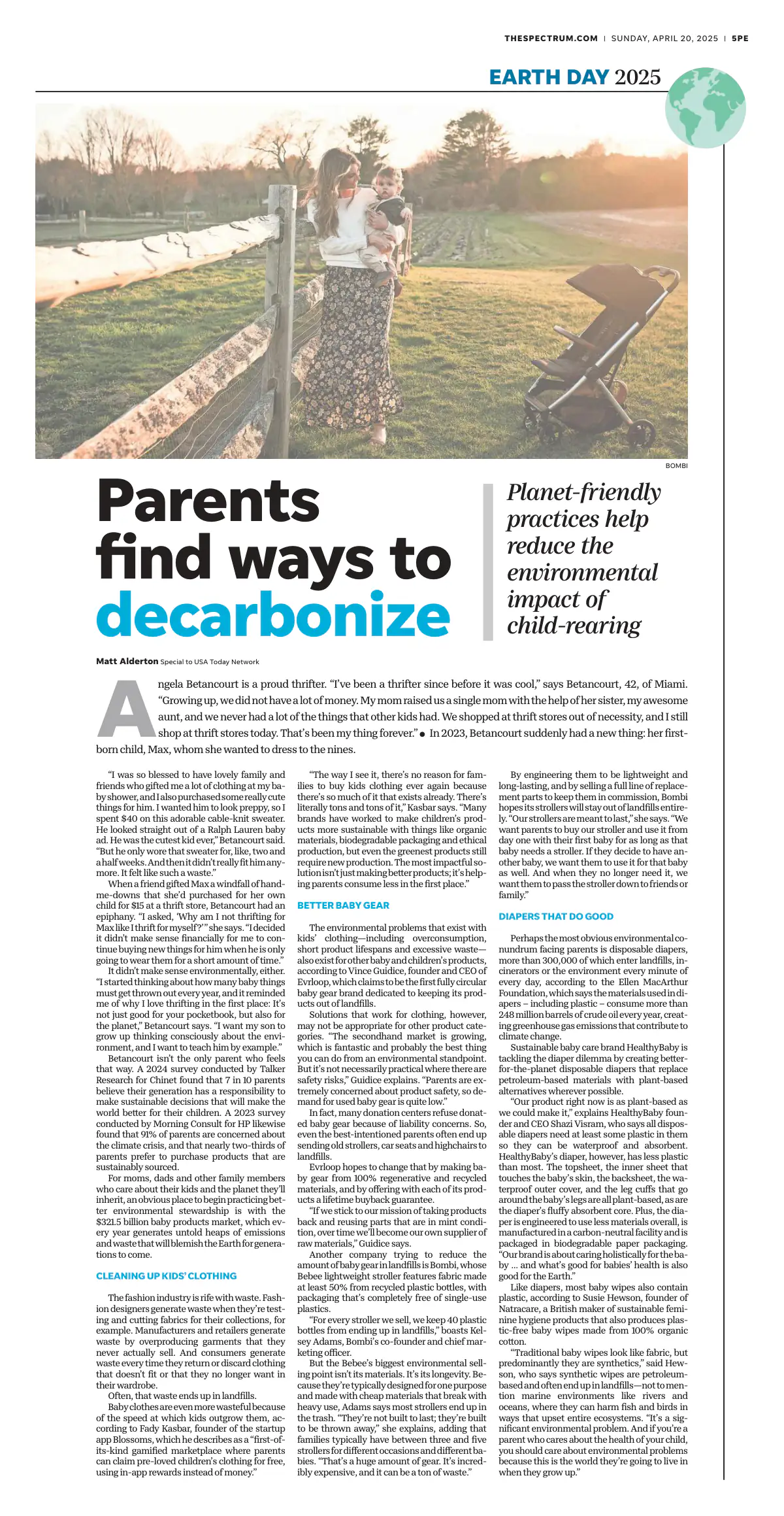
Another company trying to reduce the amount of baby gear in landfills is Bombi, whose Bebee lightweight stroller features fabric made at least 50% from recycled plastic bottles, with packaging that’s completely free of single-use plastics.
“For every stroller we sell, we keep 40 plastic bottles from ending up in landfills,” boasts Kelsey Adams, Bombi’s co-founder and chief marketing officer.
But the Bebee’s biggest environmental selling point isn’t its materials. It’s its longevity. Because they’re typically designed for one purpose and made with cheap materials that break with heavy use, Adams says most strollers end up in the trash. “They’re not built to last; they’re built to be thrown away,” she explains, adding that families typically have between three and five strollers for different occasions and different babies. “That’s a huge amount of gear. It’s incredibly expensive, and it can be a ton of waste.”
By engineering them to be lightweight and long-lasting, and by selling a full line of replacement parts to keep them in commission, Bombi hopes its strollers will stay out of landfills entirely. “Our strollers are meant to last,” she says. “We want parents to buy our stroller and use it from day one with their first baby for as long as that baby needs a stroller. If they decide to have another baby, we want them to use it for that baby as well. And when they no longer need it, we want them to pass the stroller down to friends or family.”
Diapers that do good
Perhaps the most obvious environmental conundrum facing parents is disposable diapers, more than 300,000 of which enter landfills, incinerators or the environment every minute of every day, according to the Ellen MacArthur Foundation, which says the materials used in diapers – including plastic – consume more than 248 million barrels of crude oil every year, creating greenhouse gas emissions that contribute to climate change.
Sustainable baby care brand HealthyBaby is tackling the diaper dilemma by creating better-for-the-planet disposable diapers that replace petroleum-based materials with plant-based alternatives wherever possible.
“Our product right now is as plant-based as we could make it,” explains HealthyBaby founder and CEO Shazi Visram, who says all disposable diapers need at least some plastic in them so they can be waterproof and absorbent. HealthyBaby’s diaper, however, has less plastic than most. The topsheet, the inner sheet that touches the baby’s skin, the backsheet, the waterproof outer cover, and the leg cuffs that go around the baby’s legs are all plant-based, as are the diaper’s fluffy absorbent core. Plus, the diaper is engineered to use less materials overall, is manufactured in a carbon-neutral facility and is packaged in biodegradable paper packaging. “Our brand is about caring holistically for the baby … and what’s good for babies’ health is also good for the Earth.”
Like diapers, most baby wipes also contain plastic, according to Susie Hewson, founder of Natracare, a British maker of sustainable feminine hygiene products that also produces plastic-free baby wipes made from 100% organic cotton.
“Traditional baby wipes look like fabric, but predominantly they are synthetics,” said Hewson, who says synthetic wipes are petroleum-based and often end up in landfills—not to mention marine environments like rivers and oceans, where they can harm fish and birds in ways that upset entire ecosystems. “It’s a significant environmental problem. And if you’re a parent who cares about the health of your child, you should care about environmental problems because this is the world they’re going to live in when they grow up.”
As it ran in print
Tap the page to open it full size.